



Last updated July 2026. Prices and specifications correct at time of writing.
CarExplore Score
Our overall rating for the 2026 Toyota Camry, blending expert verdicts with safety, running costs and more.
Scores updated July 2026. The Eco row has been left out because we could not read the Camry's current star rating off the Government's Vehicle Emissions Star Rating page, and we do not publish a number we cannot source. Its 15 per cent has been shared across the four rows above.
How we calculate our review scoresThe 2026 Toyota Camry is the car Australia stopped noticing and never stopped buying, and the six expert reviews we read land in much the same place: a quietly excellent hybrid sedan with one asterisk at the bowser. Toyota claims 4.0L/100km, but three of those six recorded well above it in ordinary suburban use, and every grade needs 95 RON premium. For a private buyer, the $42,990 Ascent Sport is the grade that makes the most sense.
2026 Toyota Camry key specifications
- Engine: 2.5-litre four-cylinder petrol with hybrid system (hybrid only, no petrol-only grade)
- Power and torque: 138kW / 221Nm from the engine, 170kW combined system output (Toyota does not quote a combined torque figure)
- Transmission: e-CVT
- Drivetrain: Front-wheel drive
- Price: $39,990 to $53,990 before on-road costs
- Fuel economy: 4.0L/100km combined (ADR), 95 RON premium unleaded required on every grade
- Body styles: Four-door sedan
- ANCAP: 5 stars, tested 2024 under the 2023 to 2025 protocols, 2024 datestamp, rating expires December 2031, applies to all hybrid variants
- Warranty: 5 years / unlimited km, extending to 7 years on engine and driveline with Toyota dealer servicing
- Seats: 5
- Boot: 524 litres, with a space-saver spare under the floor
How much does the Toyota Camry cost?
Before on-road costs. Correct as at July 2026.
Three grades, one powertrain, no options to agonise over. The gap that matters is the $11,000 between Ascent Sport and SL, which buys leather, a sunroof, a JBL stereo and heated everything, but not a single extra kilowatt. On CarExpert's drive-away figures for a Sydney postcode, the range runs from roughly $44,092 to $58,692, so budget close to $4,000 on top of the sticker for on-road costs.
What the experts said
We read six Australian reviews of the Camry. Two published a score, two published a graded verdict, and two we read from the written verdict. Blended and weighted, they land at 8.4 out of 10, with Carsales highest and CarsGuide lowest.
The agreement is on how the car rides. Five of the six put ride comfort or refinement in their positives, and Wheels went furthest, calling it "the best ride quality of anything at this price point". CarsGuide is the exception, and it is the interesting one: its three-month long-termer praised the suspension over big hits but reported it can get skittish over repeated small bumps, which is the sort of thing a launch drive rarely catches.
The split is over fuel. Wheels recorded 3.8L/100km on the launch route and Chasing Cars matched it at 3.8L/100km over mixed driving, both beating the 4.0L/100km claim. The three outlets that treated the car as a commuter did not: CarExpert logged 4.9L/100km, CarsGuide averaged 5.6L/100km in its first month of school runs and short trips, and Carsales recorded 6.0L/100km over a week. That is a 58 per cent spread between best and worst, and the pattern is not random. The Camry's hybrid system needs the engine to warm up and the brakes to do some regenerating, so it rewards longer runs and punishes the five-minute trip to the shops. Three of the six also named the 95 RON premium requirement as a mark against it: CarExpert, CarsGuide and Chasing Cars. The other three did not raise it at all.
Carsales on the 2025 Toyota Camry SL 9.4/10
Scored 78/100 across five categories, which maps to 9.4 on our scale (graded). Tim Britten rated it strongly for value and on-road behaviour and argued the top-spec car makes the closely related Lexus ES look expensive, marking it down for the badge, the fading segment and roadside assist being a paid extra. He recorded 6.0L/100km over a week of combined use. Published December 2025.
CarExpert on the 2026 Toyota Camry SL 9.0/10
Rated Excellent, which maps to 9.0 on our scale (graded). CarExpert does not print a number, so this is CarExplore's mapping of its published word rating. Max Davies praised the ride, refinement and a cabin he rated among the most premium in Toyota's range, and criticised the 95-octane requirement, rear headroom and the price. Recorded 4.9L/100km against the 4.0 claim. Published July 2026.
Wheels / WhichCar on the 2025 Toyota Camry range 8.5/10
No score published, editorial read 8.5. Andy Enright's launch review rated the Camry a benchmark for ride quality at the price and flagged only the divisive nose and its taxi associations as downsides. He recorded 3.8L/100km on the launch route. Published September 2024, and Toyota has not changed the car since launch.
CarSauce on the 2025 Toyota Camry Ascent Sport 8.0/10
Scored 4.0 out of 5 overall, normalised to 8.0 (scored). Matt Brand rated fuel economy a perfect 5.0 and comfort and safety 4.5, and marked the car down for having no roadside assistance included, a higher entry price than before and a powertrain that is not remotely sporty. Published December 2024.
Chasing Cars on the 2024 Toyota Camry Ascent Sport 8.0/10
No score published on this generation, editorial read 8.0. Dylan Campbell wrote that "It's a difficult car to fault", rating the handling as surprisingly fun and the boot as huge, while calling out the price rises of recent years and the premium fuel requirement. Recorded 3.8L/100km. Published September 2024.
CarsGuide on the 2026 Toyota Camry SL 7.9/10
Scored 7.9/10 (scored). Dom Tripolone ran an SL for three months and rated the cabin space, equipment and easy ownership highly, while listing the premium fuel requirement, the lack of a full-size spare and a front bumper that scrapes as the frustrations. He averaged 5.6L/100km in his first month. Published November 2025.
Note the variants. The two highest scores in that list were awarded to the $53,990 SL, and the two lowest to the $42,990 Ascent Sport, which is worth remembering before you read a 9.4 as a verdict on the base car.
Which Toyota Camry should you buy?
The value pick: Ascent Sport, $42,990. The extra $3,000 over the Ascent buys the 12.3-inch touchscreen in place of an 8.0-inch unit, a leather steering wheel instead of urethane, an eight-way powered driver's seat with lumbar adjustment, LED fog lights and a wireless charger. The mechanical package is identical to the SL's. CarExpert has made this call twice, saying private buyers should spend up to the Ascent Sport and that it is worth the extra $3,000 over the base car. Chasing Cars went the other way and argued a private buyer should stump up for the SL to escape the fleet-car feeling, which is a fair point about badge snobbery and a poor one about value.
The one to skip: SL, $53,990. It is a lovely thing, and Carsales made a fair case that it embarrasses the Lexus ES on value. But $11,000 over the Ascent Sport buys comfort and trim only, and it moves the car onto 18-inch wheels with 235/45 rubber rather than the 17s and taller 215/55 tyres of the cheaper grades. Wheels observed that a bit of sidewall helps ride quality on Australian roads.
The one worth stretching for: none. This is a three-grade range with one drivetrain, so the decision is trim, not capability. If the sunroof and the heated wheel matter to you, buy the SL knowing it is jewellery.
How the Toyota Camry compares to its rivals
| Model | Price from | Powertrain | Claimed efficiency or range | ANCAP |
|---|---|---|---|---|
| Toyota Camry Ascent | $39,990 before on-roads | 2.5L petrol hybrid, 170kW | 4.0L/100km, 95 RON | 5 stars, 2024 datestamp |
| BYD Seal 6 Essential sedan | $34,990 before on-roads | 1.5L plug-in hybrid, 130kW/230Nm | 55km EV range (WLTP), 1.1L/100km (NEDC) | 5 stars, 2023 to 2025 criteria |
| Tesla Model 3 RWD | $54,900 before on-roads | Single-motor electric, rear-wheel drive | 520km (WLTP) | 5 stars, 2025 datestamp |
| Honda Accord e:HEV RS | $64,900 drive-away | Petrol hybrid | Claimed figure not confirmed | Unrated by ANCAP |
We have left power and torque out of that table because a plug-in hybrid, an EV and two petrol hybrids do not compare usefully on a single kilowatt figure. Note the ANCAP column carefully: the Camry's stage scores were awarded under the 2023 to 2025 protocols and cannot be compared with anything datestamped 2026 or later, because ANCAP changed both the categories and their meaning on 1 January 2026.
Where the Camry wins is the boring middle: it lands about $20,000 under the Accord on drive-away figures, needs no charger and no home wallbox unlike the Model 3, and carries a five-star rating that the Accord simply does not have. Where it loses is on running cost per kilometre against the plug-ins, because the Seal 6 will do most suburban trips on a 55km battery while the Camry is buying 95 RON at every fill.
Gallery
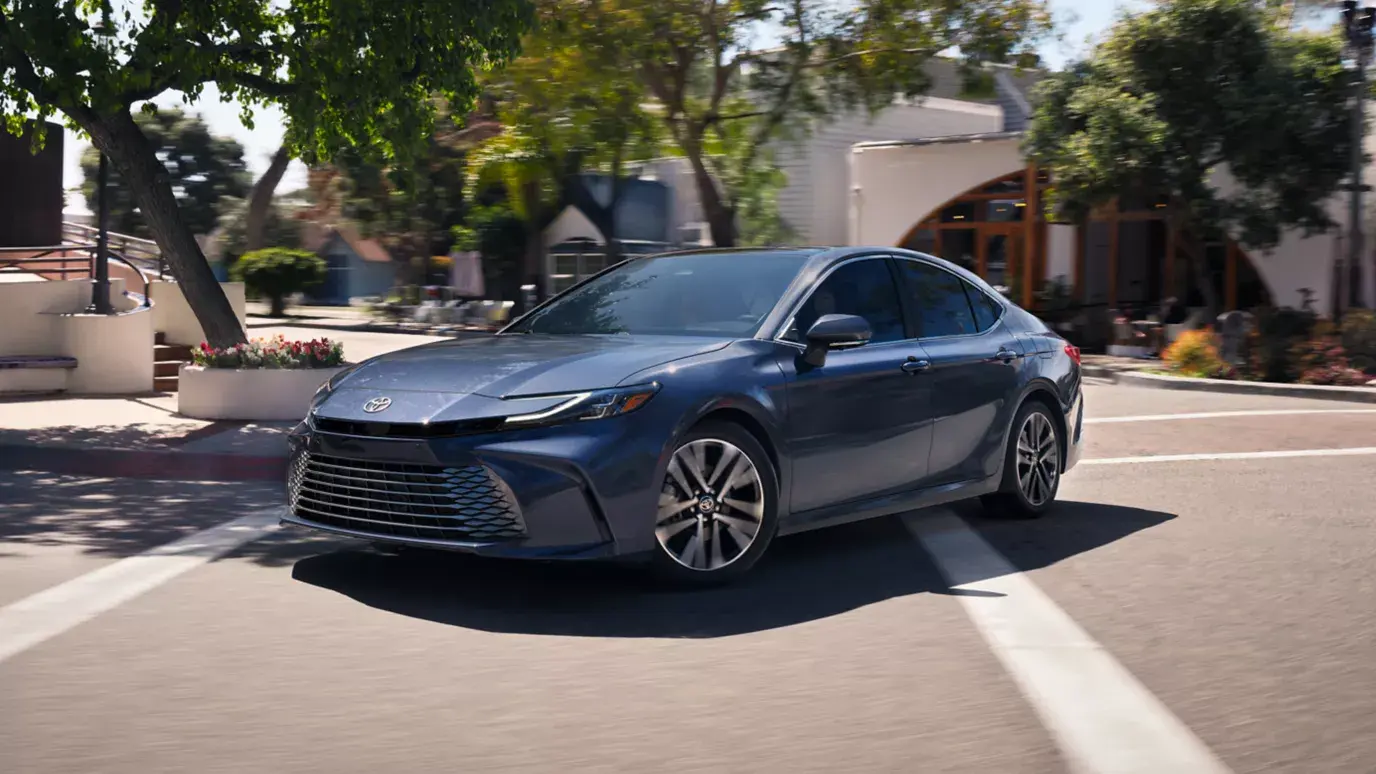
What's under the bonnet of the Toyota Camry?
One engine, one gearbox, one drivetrain. The 2.5-litre four-cylinder petrol engine makes 138kW and 221Nm on its own, the front electric motor adds 100kW and 208Nm, and the combined system output is 170kW. Toyota does not publish a combined torque figure, so nobody can. Drive goes to the front wheels through an e-CVT, and Toyota claims 7.2 seconds to 100km/h.
Reviewers were consistent on how it behaves and split on whether they liked the noise. Chasing Cars rated the chassis as more fun than it needed to be and blamed the CVT for holding the engine at a drone in Sport mode, and CarExpert described the petrol engine as a bit of a buzz box at high revs while noting it is muffled well enough not to matter. Nobody reported a rough transition between petrol and electric drive.
Towing is the number ute buyers will laugh at and Camry buyers should still know: 400kg braked, on every grade. Kerb weight is 1,625kg for the SL, ground clearance is 145mm, and there is a space-saver spare under the boot floor. That last point drew a genuine disagreement. CarExpert, Carsales and Chasing Cars all counted the presence of any spare as a win in a hybrid. CarsGuide listed the absence of a full-size spare as a negative.
Fuel economy and running costs
Toyota's claimed combined figure is 4.0L/100km and 91g/km of CO2, measured to ADR 81/02. Real-world figures from the reviews we read ranged from 3.8L/100km to 6.0L/100km, and the pattern tracked how the car was used rather than which grade was driven.
Here is the sum that matters. At 4.0L/100km and 15,000km a year, the Camry drinks 600 litres. At 205.0 cents a litre, the NRMA's Sydney average for 95 premium in its report of 27 July 2026, that is $1,230 a year, or $6,150 over five years. Add Toyota's capped-price servicing at $255 per visit for five visits, a total of $1,275, and the five-year running cost is $7,425. That scores 8.8 on our Cost of Ownership scale.
Two caveats an honest sum needs. First, at the 5.6L/100km CarsGuide averaged, the annual fuel bill climbs to about $1,722. Second, the NRMA's 27 July 2026 report warns that unleaded prices will rise by up to 16 cents a litre from 3 August 2026 when the remaining fuel excise rebate is withdrawn, which would push the five-year total to roughly $7,905. Servicing intervals are 12 months or 15,000km. Roadside assistance is not included and costs $99 or $139 a year depending on the plan, which both Carsales and CarSauce marked the car down for.'
What is the Toyota Camry like inside?
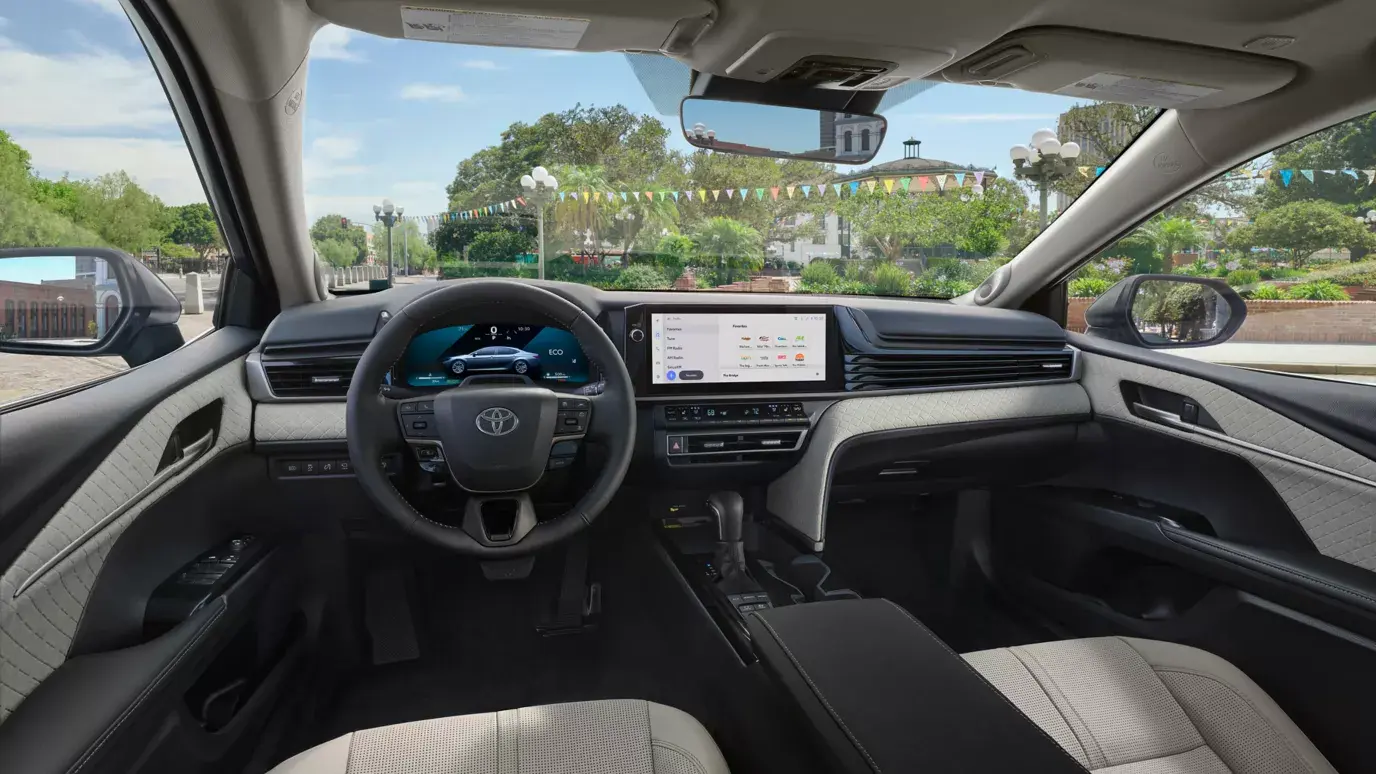
The Ascent runs a 7.0-inch instrument display and an 8.0-inch touchscreen. The Ascent Sport and SL move to a 12.3-inch touchscreen with built-in satellite navigation, and the SL adds a 12.3-inch digital instrument cluster and a head-up display. Wireless Apple CarPlay and Android Auto, DAB+ radio, dual-zone climate control and five USB-C ports are standard on every grade, along with 12 months of Toyota Connected Services.
What the base car misses is worth spelling out: cloth seats, a urethane steering wheel, manual seat adjustment, no wireless charger and no satellite navigation. Wheels was blunt about the urethane wheel in the Ascent, and Carsales described the entry car's cabin as relentlessly grey. Step up and it changes character. CarExpert rated the SL's cabin as one of the most premium in Toyota's local range, praising surfaces that look hard and turn out to be padded, and criticised the amount of gloss black on the centre console as the one part that will scratch.
The boot is 524 litres with a 60/40 split-fold rear seat. Second-row complaints were specific rather than shared: CarExpert flagged rear headroom, saying it is not limiting if you are under about 173cm, while Chasing Cars wanted more foot room under the front seats.
How safe is the Toyota Camry?
Five stars, tested in 2024, with a 2024 datestamp and a rating that expires in December 2031. It applies to all hybrid variants, which is the whole range. The four category scores were 95 per cent for Adult Occupant Protection, 87 per cent for Child Occupant Protection, 84 per cent for Vulnerable Road User Protection and 81 per cent for Safety Assist.
That 95 per cent is the headline. ANCAP recorded it as the highest Adult Occupant Protection score of any vehicle it assessed in 2024, and the Camry finished as its top overall performer for the year on a weighted score of 88.4 per cent. A rare win for the segment everyone wrote off.
One thing to hold in mind: those percentages were awarded under the protocols ANCAP retired on 31 December 2025. From 1 January 2026 the four categories became the Stages of Safety, with different names and different meaning, so a 2026-datestamped five-star result is a different achievement and the sub-scores are not comparable. Eight airbags including a front-centre airbag are standard, along with AEB with car, vulnerable road user and reverse detection, lane keeping, adaptive cruise control, blind-spot monitoring, rear cross-traffic alert and driver attention monitoring. The SL adds a surround-view monitor.
Reliability, warranty and known issues
Toyota covers the Camry with five years and unlimited kilometres, extending to seven years on the engine and driveline if you keep the logbook servicing with a Toyota dealer. The hybrid battery is covered for five years and can be extended to 10 years and unlimited kilometres provided you have the annual hybrid health inspection done as part of routine servicing from year five.
Against that, there is one open recall on the Australian register that covers this generation. Recall REC-006390, campaign 5GG31, involves 69,586 Toyota vehicles built between July 2022 and April 2025 across several model lines including the Camry Hybrid. A software problem can leave the 12.3-inch instrument display blank at start-up, taking the speedometer and warning lights with it. Toyota's remedy is a free dealer software update. Check your VIN against the notice on vehiclerecalls.gov.au before you buy used.
You may also have seen coverage of a Camry inverter bolt recall involving power loss and fire risk. As at 30 July 2026 that action applies to United States and Canadian vehicles and does not appear on the Australian recall register. Australian Camrys are built in Japan rather than Kentucky.
Pros and cons
Pros
- Lowest claimed fuel use of any non plug-in hybrid mid-size sedan on sale here at 4.0L/100km, though see the cons
- Ride comfort and refinement, praised by five of the six outlets we read
- Highest Adult Occupant Protection score ANCAP recorded in 2024 at 95 per cent
- Five years of capped-price servicing for $1,275, which on WhichCar's figures undercuts a Sonata N Line and a Mazda 6, though Honda's Accord is cheaper again at $995
- 524-litre boot with a space-saver spare still under the floor
- One drivetrain and three grades, so the buying decision is simple
Cons
- Requires 95 RON premium on every grade, which eats into the efficiency saving
- Three of the six outlets recorded 4.9 to 6.0L/100km in commuting use, well above the claim
- One open Australian recall against this generation
- $11,000 from Ascent Sport to SL buys trim only, not capability
- Roadside assistance costs extra, at $99 or $139 a year
Toyota Camry FAQs
Does the Toyota Camry need premium fuel?
Yes. Toyota specifies 95 RON premium unleaded for every Camry grade, and three of the six reviews we read named it as a drawback.
How much is a Toyota Camry in Australia?
From $39,990 for the Ascent to $53,990 for the SL, before on-road costs. CarExpert's drive-away figures for a Sydney postcode run from about $44,092 to $58,692.
Can you still buy a non-hybrid Camry?
No. The range has been hybrid only in Australia since the current generation arrived in late 2024, and there is no petrol-only or V6 option.
How much can a Toyota Camry tow?
400kg braked on every grade. It is not a tow car.
Is the Toyota Camry safe?
It holds a five-star ANCAP rating from 2024 testing that expires in December 2031, and it was ANCAP's best overall performer of that year.
How much does it cost to service a Toyota Camry?
Toyota's capped price is $255 per service for the first five services, a total of $1,275 over five years, at 12-month or 15,000km intervals.
Let's Wrap This Up
The Camry has become an outlier by standing still while everything around it grew taller. Six Australian outlets read it much the same way: comfortable, cheap to run, deeply competent, and a little dull in a way most owners will stop noticing by the second week. Cross-shop it against the BYD Seal 6 if your driving is short and suburban and you can charge at home, the Tesla Model 3 if you want an EV and a Supercharger network, and the Honda Accord only if you are certain you want to spend $20,000 more. It suits the buyer who covers real distance, wants a boot rather than a boot floor, and has no interest in ever thinking about their car again.
CarExplore's Comments
If you are a private buyer doing 15,000km a year on suburban and highway roads, buy the Ascent Sport and put the $11,000 you did not spend on the SL somewhere useful. Do the sums on 95 RON before you sign, because at 5.6L/100km and August 2026 pump prices you are looking at closer to $1,900 a year in fuel, not $1,230. And check the recall VIN list, then book the software update at your first service rather than making a separate trip for it.


Discussion